Soundscapes
An Overview
As part of my Fundamentals of User Experience course at the University of Toronto iSchool, I worked with Akram Wahden, Val Masters, and Zahra Rajabi to produce a prototype version of Soundscapes, an application that provides an immersive auditory experience, via your smartphone.
Soundscapes is a mobile application that simplifies recording, re-living, sharing and exploring auditory experiences.
I shared many roles with my team, with my strengths being in user research, design strategy, and prototyping. My skills in psychology enabled me to better empathize with our users during research and testing. I also drew heavily from my visual art background when co-designing the user interface and was also the team’s lead sketcher and storyboarder.

The Beginning
My team was interested in sound as an underutilized sense in design, believing that audio holds incredible power to move, ignite inspiration, and ground oneself in a sense of place. Finding the current state of sound based experiences focuses primarily on sound being a by-product of other visual and textual experiences, we realized what the existing solutions fail to address is the need to recognize sound as a primary and viable resource of placemaking and connectivity. Enter Soundscapes.

Understanding the Users
To understand how our product could serve users needs we conducted a survey and semi-structured interviews, a literature review, and a market analysis of potential competitors.
Quantitative results from our online survey of thirty-five characteristic users from Canada, Egypt, and the United States:
Demographics
- 80% live in urban environments
- 85% are age 18-35
- 100% are smartphone users
Current Habits
- 70% use streaming services like Apple Music and Spotify
- 35% use podcasts
- 60% consider sound when planning travel/sightseeing (ocean breeze, noise pollution, etc.)
Desires & Engagement
- 80% want place-based sound exploration
- 60% are interested in an app that brings people together through sound
- 30% would create sound content themselves
Qualitative results from our six semi-structured interviews:
- Most users found sound to be an essential part of events and everyday life.
- Users primarily interacted with sound through podcasts, music, ambient environment
- Users typically listened while they were doing something else — like cooking!
- Some users described sound as an integral part of their experience of a place — one user recalled her trip to Mecca, “When I visited Mecca, it was very loud… but it was amazing and a huge part of the experience”
- Users were most interested in profile and people-based listening, as well as place exploration via sound.
- Users had a desire to explore non-traditional media, and would be curious to engage with a sound-based platform.
Outcomes from our literature review and competitive analysis:
- Identified several competitors (for example Soundcloud, Spotify, Audible, Soundaroundyou, StoryCorps, Montreal Sound Map, et al.), but none that were Toronto-based.
- Mapped the technical structures of other audio platforms including their design and content generation methods.
- Several had unapproachable UIs — fairly rigid and could benefit from more personalized and dynamic user-generated content.
- Led to our decision to incorporate curated content in our project.

Meet Mariam, Our User Persona

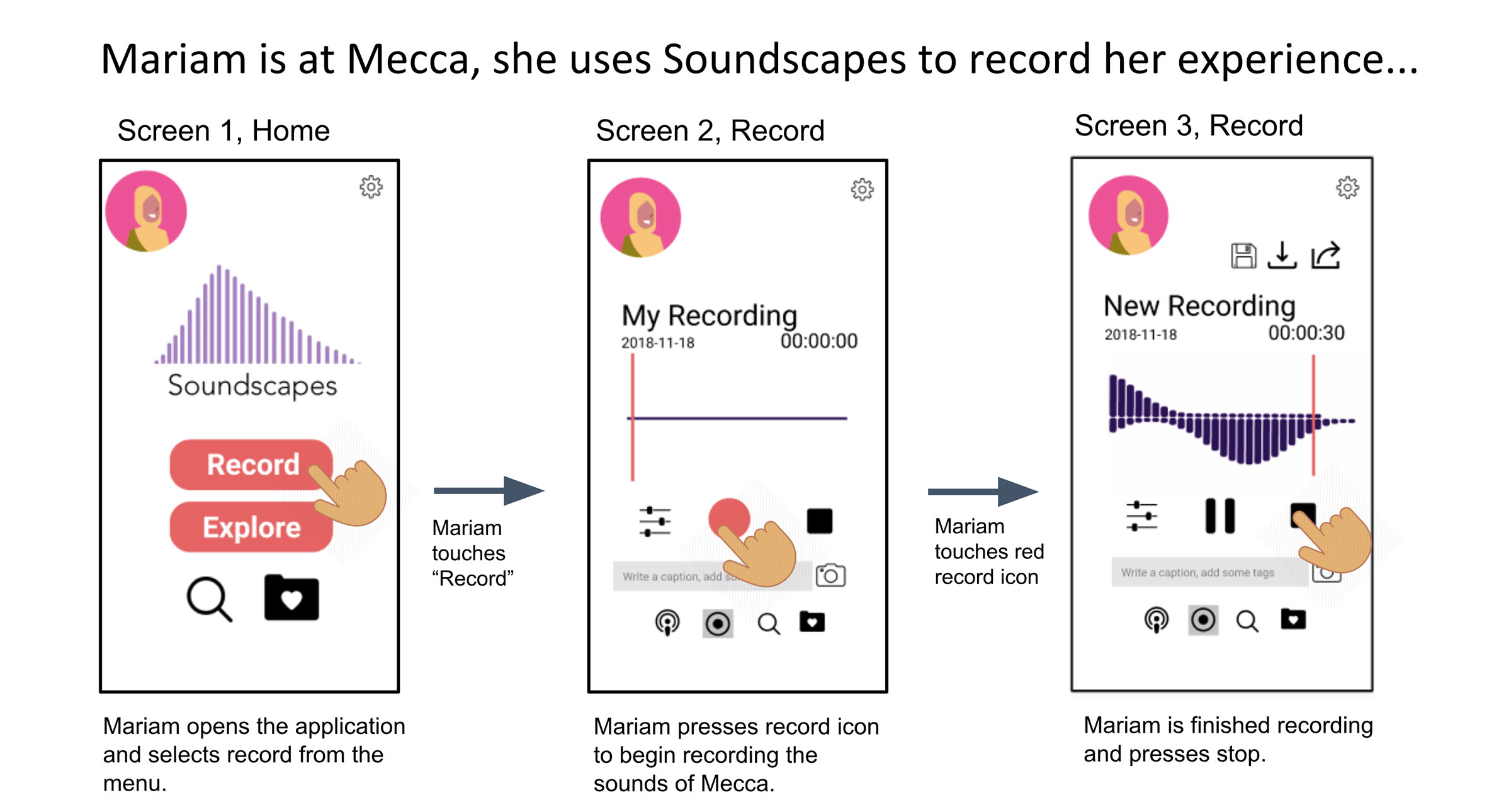
Mariam wasn’t satisfied with the current social media platforms and recording mediums available to her to share and relive her meaningful experiences. Photos were too static, videos didn’t leave enough room for her imagination, and neither were capable of conveying the richness she felt when she was at Mecca.

Prototype, Test, Repeat
Our next step was to sketch up our ideas into a low-fidelity paper prototype based on Mariam’s identified goals:
- Needs to record an experience through sound.
- Wants to access her recording anytime.
- Wants to share her recordings with others.


To test our paper prototype, we did a lean usability test at the University of Toronto’s iSchool library with four iSchool students, aged 20-30 and social media users, who ranged in their streaming usage, from average to high. Examples of apps used by this user group included Instagram, SoundCloud, Spotify, Google Music, and podcasts.

We categorized the user feedback into likes, criticisms, questions, and ideas, which we incorporated into our medium-fidelity prototype that we built in Figma.


More User Testing
We used InVision to test our Figma medium-fidelity prototype with three representative users at the iSchool, using an iPhone 8 as the testing device. Our main goals were to test if our prototype had clear functionality, ease of use, and consistency in its UI, as well evaluating the interest in our application from users with varying levels of familiarity with sound-based tools.
Usability testing involved three methods:
- Semi-structured interview
Gave us additional context and user demographic information. - Cognitive walkthrough
Users completed three tasks in the prototype:- Make and edit a recording.
- Listen to the recording and share it.
- Explore others’ content.
- Observation
Allowed us to identify specific pain points.

Overall our medium-fidelity prototype received a positive reception from the users we tested with. Users responded well to the interface and were able to complete the tasks without much hesitation or error-correction.
The main pain points and critical feedback from users were concerned with:
- UI improvements
- Icons better adhering to the user’s mental models.
- How to best preview sounds in browse/explore — is an image really the best way to do this?
- Workflow
- Streamlining the editing process (simple audio filters versus complex controls)
- Consent and legality with respect to public audio recording, and content moderation.
What’s Next for Soundscapes?
Turning Soundscapes into a viable product will take some work. As we have only tested the medium-fidelity prototype with three users, more user testing will be our first step before creating another iteration based on the summative feedback results. Once we are satisfied with our changes, we will move on to a high-fidelity prototype, and then — more testing! Issues around content moderation will also need to be further researched before the project is built — as with any user-generated platform care would need to be taken to ensure the platform was being used ethically and without harm to others.
Stay tuned (in)!